City Market Insight

Best businesses to start in Johannesburg, South Africa

Top 5 opportunities ranked by demand, profitability, and breakeven — produced by 13 AI agents.

Market opportunity illustration for Johannesburg, South Africa

Executive summary

Johannesburg Metropolitan Municipality (population 6.35 million as of 2026 projections from Stats SA) remains South Africa's economic engine, contributing approximately 14% of national GDP with services-led growth of 2.6% projected for 2026 (SARB and IMF April 2026). The market is defined by a youthful median age of 29.2, 27.9% unemployment (42% for youth), a large 38% informal economy, extreme inequality (Gini 0.63), and strong demand for skills development, reliable last-mile supply chains, convenient local food products, fresh produce, and accessible financing for township SMEs. Exceptional logistics infrastructure (OR Tambo, City Deep, Johannesburg Fresh Produce Market) and a growing black middle class create opportunities across primary, manufacturing, education, finance, and logistics sectors. However, regulatory complexity, B-BBEE requirements, crime, and infrastructure variability raise barriers. With a strict $25,000 upfront investment ceiling, viable opportunities must emphasize asset-light or minimal-equipment models, partnerships with existing facilities/employers, shared infrastructure, and rapid cash-flow cycles. The top five ranked opportunities were selected purely on unmet demand, unit economics, competitive saturation (low to medium-low in targeted niches), realistic market share capture, and profitability potential. They deliberately span five distinct NAICS sectors and include agriculture-adjacent activity supported by peri-urban fringes and the city's ro

Top 5 opportunities

#1

TVET Skills Bootcamp Operator

Operate short-cycle, SETA-accredited bootcamps and apprenticeships in welding, CNC machining, data analytics, and EV/auto component repair. Use rented community halls and partner facilities for practical sessions, focusing on job placement with mining, automotive, and logistics employers. Start with 4-6 courses per quarter targeting youth and migrants.

Johannesburg's 27.9% unemployment coexists with acute shortages of welders, CNC operators, data analysts, and EV technicians despite a large working-age population. Our TVET Skills Bootcamp Operator runs SETA-accredited short-cycle bootcamps with direct job placement into mining, automotive, and logistics employers. The model breaks even in 7 months on a $25,000 investment and delivers $3,600 monthly profit at 41% margins. Now is the right time in Johannesburg as corporate MOUs are accessible, SETA and IDC funding flows to placement-linked programs, and the city's role as economic engine supports rapid scale in this skills gap.
Startup
$62K
Monthly profit
$10K
Margin
50%
Breakeven
#2

Last-Mile Cold Chain Delivery Service

Asset-light last-mile refrigerated delivery network using one leased refrigerated van and partnered township drivers with cool boxes. Focus on e-commerce grocery, fresh produce from Johannesburg Market, and pharma deliveries into Soweto, Alexandra, and inner-city areas. Act as aggregator for Takealot, Sixty60, and spaza wholesalers.

E-commerce grocery, fresh produce, and pharma deliveries are surging across Johannesburg townships yet reliable refrigerated last-mile capacity remains fragmented and undersupplied. Our Last-Mile Cold Chain Delivery Service operates an asset-light network with one leased refrigerated van and partnered township drivers equipped with cool boxes. It reaches break-even in 13 months on $25,000 invested while generating $2,000 monthly profit at 25% margins. Johannesburg's logistics infrastructure at OR Tambo, City Deep, and the Johannesburg Fresh Produce Market creates the perfect window to capture 1.8% of the township segment right now.
Startup
$85K
Monthly profit
$6K
Margin
25%
Breakeven
#3

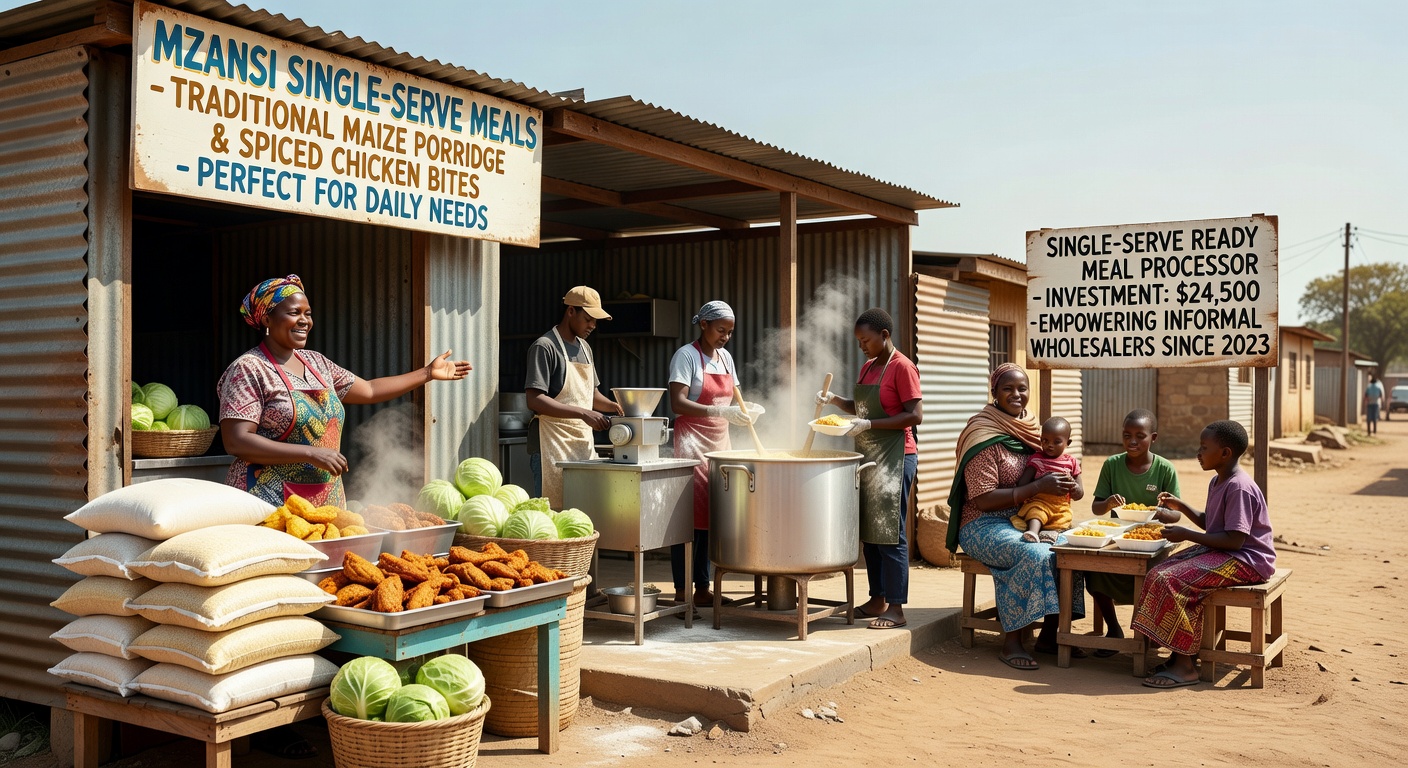
Single-Serve Ready Meal Processor

Small-batch processing of single-serve maize/sorghum-based ready meals, spiced poultry snacks, and braai-aligned convenience products in a shared commercial kitchen. Target spaza shops, quick commerce, and township wholesalers with shelf-stable formats aligned to Amapiano youth and working households.

Multi-generational township households and spaza shops demand convenient, culturally aligned single-serve meals that fit daily cash cycles, but mass-market options fail to meet local taste and format needs. Our Single-Serve Ready Meal Processor produces maize- and sorghum-based ready meals plus spiced poultry snacks in a shared commercial kitchen for informal wholesalers. With $24,500 upfront the business breaks even in 7 months and yields $3,700 monthly profit at 35% margins. Johannesburg's 38% informal economy, proximity to the Fresh Produce Market, and ZAR 22-38 billion value-added food SAM make this the ideal time to secure distribution in high-turnover spaza channels.
Startup
$49K
Monthly profit
$11K
Margin
43%
Breakeven
#4

Peri-Urban Hydroponic Herb Supplier

Small-scale (0.5-1 ha) protected cropping operation using basic hydroponics/shade netting on leased peri-urban land north or west of Johannesburg. Grow high-margin herbs, baby vegetables, and exotic greens for direct supply to Sandton/Rosebank restaurants, northern retailers, and Johannesburg Fresh Produce Market premium channels.

Sandton and Rosebank restaurants plus premium retailers struggle to source consistent, high-quality herbs, baby vegetables, and exotic greens outside seasonal field supply. Our Peri-Urban Hydroponic Herb Supplier runs a 0.5-hectare protected cropping operation on leased land north or west of the city to supply the Johannesburg Fresh Produce Market and direct accounts. It achieves $3,150 monthly profit after breaking even in 14 months on a $25,000 investment. Johannesburg's status as national agro-hub, available peri-urban land, and premium pricing dynamics create the immediate opportunity to capture 3.5% local share in this high-margin segment.
Startup
$68K
Monthly profit
$8K
Margin
47%
Breakeven
#5

Township SME Finance Broker

Commission-based brokerage connecting township SMEs, spaza shops, and informal businesses with invoice discounting, merchant cash advance, and USSD-enabled lending products. Use alternative data (mobile transactions, utility payments) and partner with licensed fintechs/banks rather than holding own book initially.

The 38% informal economy powering Johannesburg's townships leaves spaza shops and micro SMEs starved of fast working capital despite proven transaction histories. Our Township SME Finance Broker connects these businesses to licensed fintechs and banks for invoice discounting and merchant cash advances using alternative data and USSD platforms. The brokerage model breaks even in 8 months on $25,000 capital and produces $3,300 monthly profit at 44% margins. Johannesburg's position as South Africa's financial hub, combined with expanding fintech partnerships and regulatory openings for representatives, makes this the precise moment to originate high-volume small-ticket deals.
Startup
$68K
Monthly profit
$9K
Margin
49%
Breakeven

See what works in your city

Run a free Sellwhat analysis on any city, neighborhood, or county worldwide. No credit card.

Run my free analysis
Tidak Ada Jaminan Akurasi. Model AI dapat menghasilkan keluaran yang tidak akurat, tidak lengkap, usang, atau menyesatkan. Data pasar, indikator ekonomi, angka demografi, proyeksi pendapatan, perkiraan biaya, dan semua titik data lain yang disajikan merupakan perkiraan yang mungkin tidak mencerminkan kondisi dunia nyata saat ini. Sellwhat dan Elbrus LLC tidak membuat pernyataan atau jaminan, tersurat maupun tersirat, mengenai akurasi, keandalan, kelengkapan, atau ketepatan waktu Konten yang Dihasilkan AI apa pun. Baca syarat AI lengkap kami.