City Market Insight

Best businesses to start in Amsterdam, Netherlands

Top 5 opportunities ranked by demand, profitability, and breakeven — produced by 13 AI agents.

Market opportunity illustration for Amsterdam, Netherlands

Executive summary

Amsterdam's metropolitan economy (projected 2.4% real GDP growth in 2026, €185 billion metro GDP) is driven by finance (19% employment), ICT/tech (16%), logistics tied to Schiphol and Port of Amsterdam, hospitality/tourism, and surrounding North Holland polder agriculture (flowers, vegetables, dairy). The 942,000-resident municipality (2.6 million metro) features a young, highly educated (44% tertiary), multilingual workforce with 3.9% unemployment yet persistent skilled-labor shortages in logistics automation, food processing, and tech support. High single-person households (53%) and 35% non-Western migrant background create strong demand for convenience foods, ethnic specialties, and efficient B2B supply chains. Low saturation exists in suburban-ring specialized operations and exurban specialized horticulture, while strict urban-core zoning pushes primary, manufacturing, wholesale, and logistics activities to the ring or fringe. All recommended opportunities are scoped to feasible launch within the $1M upfront budget at break-even scale by emphasizing leased facilities, targeted recruitment via the highly-skilled migrant program, and niche positioning against incumbents. Commercial potential is highest in addressing labor gaps, leveraging polder production for value-added chains, and serving Schiphol-linked perishables trade in a stable operating environment (1.00x cost multiplier). Financial outlook: Break-even scale requires €0.45M–€1.02M upfront investment per opportunit

Top 5 opportunities

#1

Logistics Skills Training Academy

Employer-specific technical and vocational training programs, including warehouse automation, forklift operation, logistics IT systems, fintech support, and customized upskilling for suburban logistics and tech employers. Delivered via hybrid in-person/simulation courses with placement support and corporate retainers.

Amsterdam's logistics operators and tech firms face persistent skilled labor shortages in warehouse automation, forklift operation, and systems integration despite 3.9% unemployment. The Logistics Skills Training Academy, sited in the suburban ring at Schiphol Trade Park or Zaanstad, delivers employer-specific hybrid training programs and placement support under corporate retainers to reach €1.1-2.0 million in annual revenue within three years. With Schiphol expansion driving demand and stable 2026 labor market conditions at 2.4% GDP growth, this is the right time to launch from a suburban hub with direct employer access and lower operating costs.
Startup
$1.8M
Monthly profit
$102K
Margin
54%
Breakeven
#2

Supply Chain Integration Consultancy

Applied consulting and software integration services focused on route optimization, cold-chain tracking, automation integration, and last-mile efficiency for food wholesalers, perishables handlers, and light manufacturers operating between polders, Schiphol, and urban core.

Mid-market food wholesalers and perishables handlers in the Amsterdam metro lose efficiency in route optimization, cold-chain tracking, and last-mile delivery under canal and road constraints. The Supply Chain Integration Consultancy, based in the urban core at Zuidas or Noord, provides practical implementation and software integration services focused on SMEs to achieve break-even in 16 months with €27,500 monthly profit. Amsterdam's role as EU logistics gateway combined with e-commerce growth and post-2025 political stability makes now the moment to capture share in this €2.8-4.2 billion professional services segment.
Startup
$950K
Monthly profit
$90K
Margin
53%
Breakeven
#3

Specialty Contract Grower

Mid-sized horticultural operation focused on contract growing of niche cut flowers, culinary herbs, ethnic vegetables, and specialty cultivars for Aalsmeer auction, urban wholesalers, ethnic retailers, and high-end hospitality, with integrated grading and year-round supply agreements.

Wholesalers, ethnic retailers, and hospitality operators struggle with inconsistent year-round supply of niche cut flowers, culinary herbs, and ethnic vegetables from volatile auctions. The Specialty Contract Grower, located on the exurban fringe in Waterland or Haarlemmermeer polders, secures long-term contracts with integrated grading and premium cultivars to generate €1.0-2.4 million in annual revenue. Local water infrastructure, diverse population demand, and 2026 metro GDP growth of 2.4% create the ideal conditions to scale specialized horticulture operations now from cost-advantaged exurban land.
Startup
$2.3M
Monthly profit
$90K
Margin
51%
Breakeven
#4

Ethnic Convenience Wholesale Distributor

Specialized wholesaler focused on small-portion ethnic foods, ready-to-eat components, premium dairy, fresh herbs, and culturally adapted produce for hospitality, ready-to-eat manufacturers, restaurants, and urban retailers, integrated with cold storage and cargo-bike compatible packaging.

Single-person households and hospitality providers lack efficient supply of small-portion ethnic foods, ready-to-eat components, and culturally adapted produce for just-in-time needs. The Ethnic Convenience Wholesale Distributor, sited in the suburban ring at Haarlemmermeer or Zaanstad, combines polder and Schiphol sourcing with cold storage and cargo-bike packaging to deliver €1.4-3.1 million in annual revenue from 120-280 B2B accounts. With rebounding tourism, suburban zoning advantages, and a stable low-risk operating environment in 2026, this is the precise time to establish this high-turnover distribution business.
Startup
$1.6M
Monthly profit
$87K
Margin
28%
Breakeven
#5

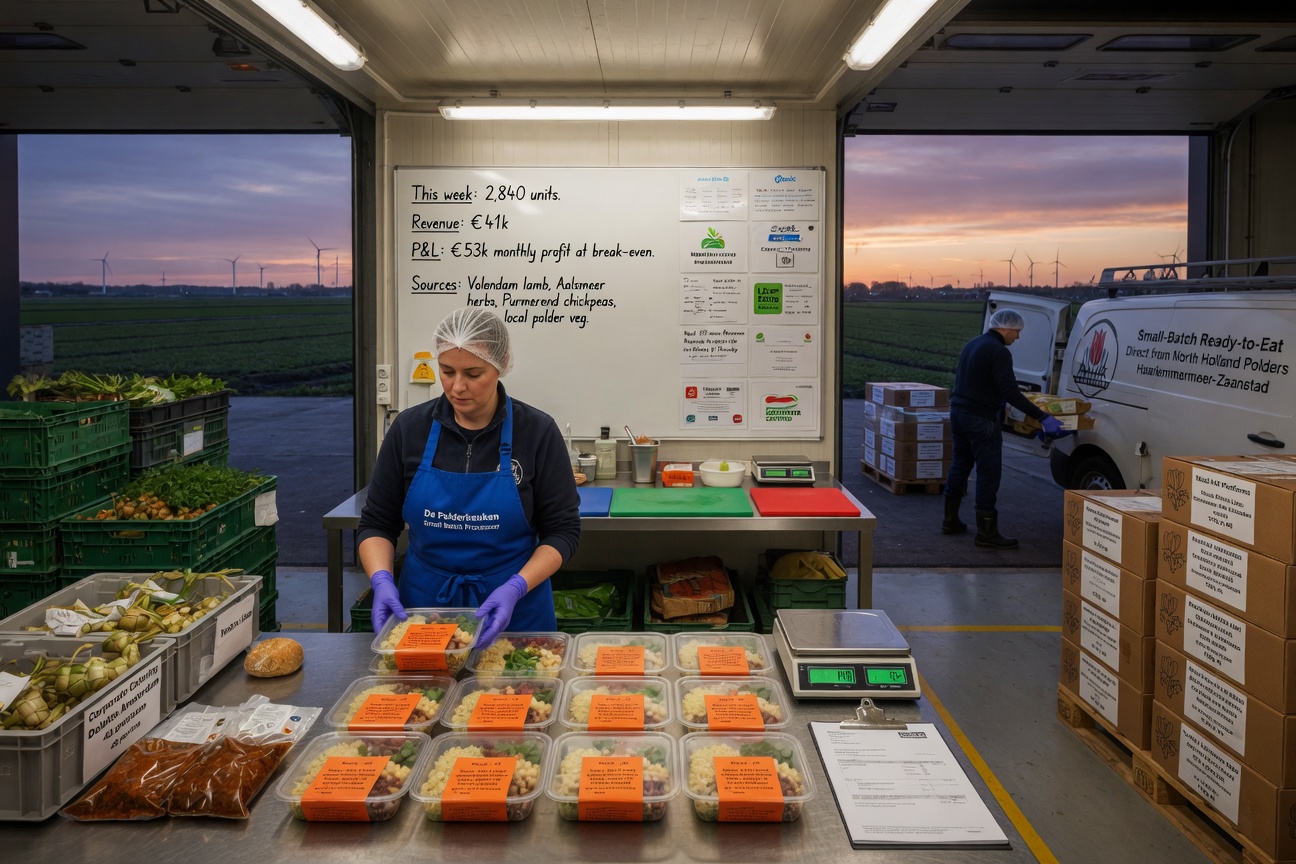
Small-Batch Ready-to-Eat Processor

Mid-scale value-added food processing operation producing small-batch ready-to-eat meals, packaged ethnic specialties, convenience salads, and portion-controlled dairy/vegetable items sourced from local polders for hospitality, retailers, meal-kit platforms, and corporate catering.

Retailers, meal-kit platforms, and corporate catering demand small-batch ethnic ready-to-eat meals, convenience salads, and portioned items that mass producers cannot efficiently supply. The Small-Batch Ready-to-Eat Processor, operating in suburban ring industrial parks in Haarlemmermeer or Zaanstad, sources directly from North Holland polders to hit €53,000 monthly profit at break-even scale within 19 months. Strong category growth, labor availability via migrant programs, and Amsterdam's 2.4% GDP expansion in 2026 make this the optimal window to launch value-added processing with compliant suburban infrastructure.
Startup
$2.6M
Monthly profit
$147K
Margin
39%
Breakeven

See what works in your city

Run a free Sellwhat analysis on any city, neighborhood, or county worldwide. No credit card.

Run my free analysis
Keine Garantie für Richtigkeit. AI-Modelle können ungenaue, unvollständige, veraltete oder irreführende Ausgaben liefern. Marktdaten, Wirtschaftsindikatoren, demografische Angaben, Umsatzprognosen, Kostenschätzungen und alle anderen dargestellten Datenpunkte sind Näherungswerte und spiegeln möglicherweise nicht die aktuelle Realität wider. Sellwhat und Elbrus LLC übernehmen keine ausdrückliche oder stillschweigende Zusicherung oder Gewährleistung hinsichtlich Richtigkeit, Zuverlässigkeit, Vollständigkeit oder Aktualität von AI-generierten Inhalten. Vollständige KI-Bedingungen lesen.